Would you like to have been a kid when the wheel was invented, thousands of years ago? Life would have been very different.
Juan is a third grader in Los Angeles today. He's never been really hungry or thirsty. Sometimes Juan goes on shopping trips with his parents. The supermarket is full of things to buy! He can get oranges from California, bananas from Costa Rica, mangos from Mexico, and oysters from the ocean. When he gets thirsty, he can drink fresh water right out of the kitchen faucet.

Juan has warm clothes to wear, and his classroom is warm, too. He has all his teeth -- except his baby teeth! -- and is healthy. If he were sick, his mom could take him to see a doctor.
Juan knows how to read and write. He can talk to friends on the telephone, check out books and look at photos in the school library. He can watch television shows from faraway places and use the internet to visit web sites around the world.
He can go on trips in a bus, or on a train, or in a car, or on a bike, or even in a plane. On weekends, his mom or dad drive him to Montebello to play in his soccer league, or to his friend David's house for a sleepover.
La'um is a boy in ancient Mesopotamia, four thousand years ago. He's the same age as Juan, but isn't nearly as big or healthy. La'um once almost starved to death, after a flood destroyed most of his family's farm.1 He's been hungry and thirsty many times.

La'um wears a sheepskin skirt and shoes made from leather. The skirt is okay when it's warm, but sometimes he's cold in the winter. He has to climb a rocky hill to get to his home, and his feet hurt a lot. And his joints always hurt.2 He drank some funny tasting water a few months ago, and since then he's had headaches and chills, and his muscles ache all the time.3
La'um has never traveled more than a couple of miles from where he was born. He helps his parents work, and plays with his brothers and sisters. That's his whole life.
To La'um, Juan would seem fantastically rich! He can make bright light in a dark room, just by flicking a switch. He can take a shower or hot bath whenever he wants. He can wear clothes that protect him against terrible cold, and travel faster than a running horse, and use special machines to see and talk to people thousands of miles away. No king in Mesopotamia ever lived as well!
But there's a problem.
The machines that make Juan's life easier also make pollution. Power plants burn coal and gas to make the electricity that make Juan's computer and television go, and that give him light to read and study by. Big pipes carry natural gas underground to his home, to keep his room warm and heat the water for his shower.

Miners dig the coal from the ground. The mining makes waste, and can cause water pollution, when rain contaminated by the mining flows into rivers and streams. Power plants send pollutants into the air as power plants burn coal.4
Juan's warm clothes, computer, mp3 player, and television were made in factories, and the factories make pollution, too. So do trucks, trains and planes, when they carry the food that Juan likes to the supermarket.
Pollution isn't new. People built fires in their homes to stay warm in La'um's day, and breathed in the smoke the fires made.5 Before 1956, most people in London, England burnt coal and wood in their homes. The air became so polluted one year that some Londoners walked into the Thames river; they couldn't see where they were going!6

And early factories all over the world made much more pollution than factories do today. In a few cities in the 1950s, cars sometimes stalled for lack of oxygen.7 Even the cars couldn't breathe!
But in La'um's day, only five to twenty million people lived on the entire earth.8 Today nearly seven billion do 9 ... almost 1,400 times as many! Most of them want to live in warm rooms, and wear warm clothes, and eat good food, like Juan. And they want to use computers, televisions, mp3 players and other modern machines, too.
The machines that make our lives more comfortable are changing the earth. And it's hard to think of a machine that has changed the earth as much as the personal car.
The photo below is famous. It shows how much space is needed to transport sixty people by car, by bus, and by bicycle.

Cars use lots of space! Half of the space in United States cities is for roads, parking lots, parking buildings and other vehicle-related uses.10 In Los Angeles, two-thirds of the space is for vehicles. 11
Cars make a lot of pollution, too. Factories can make over 100,000 pounds of waste just to make one 3,500 pound car.12 Building a car can make as much air pollution as driving the car for ten years.13
Auto makers put special controls on car engines, so they will make less pollution when people drive them. A modern car makes much less pollution when it's running than a car did in the 1950s. The air in cities like Los Angeles is much cleaner than it used to be.
But running cars still make pollution. In California, passenger cars and trucks still make nearly two million pounds of smog-forming pollution every day! 14
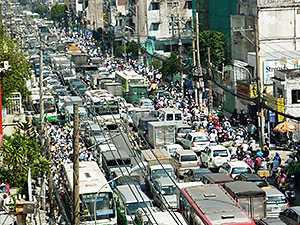
A hundred years ago, there were about a million vehicles on earth.15 By 2020, there will be over two billion!16 And eighty-five percent of the world's people still don't own a car.17 Many scientists are worried about what will happen when these people can afford to buy cars, too.
But look at the picture again.

What would you rather ride in, on a cold, rainy night in winter?
You'd get wet, if you rode a bicycle! You might have to stand in the rain at a bus stop, if you rode a bus ... and stand all the way home, if there weren't enough seats.
If you drove a car, you wouldn't have to wait at all. You'd have your own seat, and could turn the heat up the way you like it, and go straight to where you wanted to go, and listen to music while you drove.

You might not even have to use your umbrella!
"Tragedy of the commons" is a phrase that some adults use for a situation like this. A community is better off if people act one way. But each single person in the community is better off by doing something else!
Today about five percent of Americans use public transit to go to work. Most of the rest drive cars.18
Sometimes adults want other people to give up cars, but don't want to give up cars themselves. In 2006, the mayor of Los Angeles used to encourage people to ride transit. It turned out that he almost never rode transit himself, even though he lived right next to a big transit stop!19 And only one percent of the people who work for the Los Angeles transit agency use transit to go to work. The rest are drivers.20
There's another problem.
After a city has been built, it's hard to change the way that people travel in it.
Singapore is a big city in Asia. It has a big rail system, and offices and high rise apartments clustered around the rail stations. Owning a car in Singapore is very expensive.

The city planners want people to ride trains and buses more than they ride cars ... and they do! Most Singapore trips are by public transit.21
The San Fernando Valley is an urban area near Los Angeles. Many of the streets are wide, and the homes are spread out. Some of the buses only run once an hour, and the bus stops are far apart. It's very hard to travel by bus or train. Most adults travel by car.
This map shows the Los Angeles rail system in the 1920s. Los Angeles would be a very different city today, if it had kept this rail system and kept growing around it.

But it didn't. The tracks were torn up, and freeways were built. And now it's too late to change.
Adults agree that kids should listen to their parents and stay safe. But they disagree about a lot of other things ... and how people should travel is one of them.
Many adults are in favor of more travel by public transit, paratransit and bicycles. Here are some of their arguments:
• Travel by private car pollutes much more than travel by transit or bike.
• Private cars use up much more space than buses, trains or bicycles.
• Cars get in terrible traffic jams because there are so many of them on the road.
• Driving is much more dangerous than using public transit.
• People wouldn't drive so much if there weren't so much free parking!
Other adults think that public transit is a technology of the past, like typewriters. Some of them say:
• It's too late to change. America's road system has already been built.
• Most people prefer driving. People still buy cars in Singapore, even though the government makes them pay thousands of dollars in taxes. That shows how much people like cars!
• Private cars let people live like kings! They can live in places with big, spread out homes, far from the city. Their cars give them freedom. It's not fair that only rich people should have cars; everyone should be able to buy one.
• The American economy depends on cars. Think of all the car dealerships, mechanics, gas stations, auto parts stores and car washes that need cars to stay in business!
You're not going to be a kid forever. Some day your teachers and parents are going to be old. You might be one of the people in charge.
Many grown-ups know than pollution is a problem. They're trying to make changes, so life will be better when you're an adult.
Los Angeles and many other cities are building homes close to transit centers, so people don't have to own cars. More governments are opening special lanes for cyclists, too.
And car makers are building cars that pollute less. Today some cars run on hydrogen and electricity. Cars already pollute much less than cars did when your mom and dad were kids. They're going to get better still.
What decisions will you make, if you become a mayor or governor or president some day? How will you protect the earth, and let people live well at the same time?
Next : Chapter Four Quiz
Or : Return to Cover
1 Ancient Mesopotamian Farming
2 Decline of Mesopotamia
3 Typhus
4 Union of Concerned Scientists, Coal vs. Wind
5 J.R. McNeill, Something New Under the Sun, (W.W. Norton and Company, 2000), pg. 55
6 McNeill, pg. 66
7 McNeill, pg. 70
8 U.S. Census Bureau, Historical Estimates of World Population
9 U.S. Census Bureau, U.S. & World Population Clocks
10 Peter Freund and George Martin, The Ecology of the Automobile, (Black Rose Press, 1993), pg. 19
11 Ibid
12 McNeill, pgs. 310 - 311
13 Ibid
14 Environment California Clean Air Program Reports
15 McNeill, pg. 60
16 Daniel Sperling & Deborah Gordon, Two Billion Cars, (Oxford University Press, 2009), pg. 4
17 Ibid
18 Commuting in the United States: 2009, pg. 2
19 Mayor rides the SUV, not the MTA
20 Metro Explains Why It Deleted Facebook Comments
21 Robert Cervero, The Transit Metropolis, (Island Press, 1998), pg. 164
 |
